Physical Address
304 North Cardinal St.
Dorchester Center, MA 02124
Physical Address
304 North Cardinal St.
Dorchester Center, MA 02124

Running a small business means wearing many hats. One day you’re answering customer emails, the next you’re creating marketing posts, managing invoices, updating your website, or tracking sales. Hiring a large team isn’t always possible, especially for startups and growing businesses.
That’s where AI Tools for Small Businesses can make a real difference.
Modern AI tools are no longer designed only for large companies. Today, affordable and beginner-friendly solutions help small business owners automate repetitive work, create marketing content, improve customer support, organize projects, analyze data, and save valuable time.
Instead of replacing people, these tools help business owners focus on high-value work such as serving customers, developing products, and growing revenue.
In this guide, you’ll discover the best AI tools for small businesses, learn what they do, compare their features, understand their advantages and limitations, and find practical ways to use them in everyday business operations.
AI Tools for Small Businesses are software applications that use artificial intelligence to automate tasks, assist with decision-making, generate content, improve communication, and increase productivity.
These tools can help with:
Many of these platforms offer free plans, making them accessible even for businesses with limited budgets.
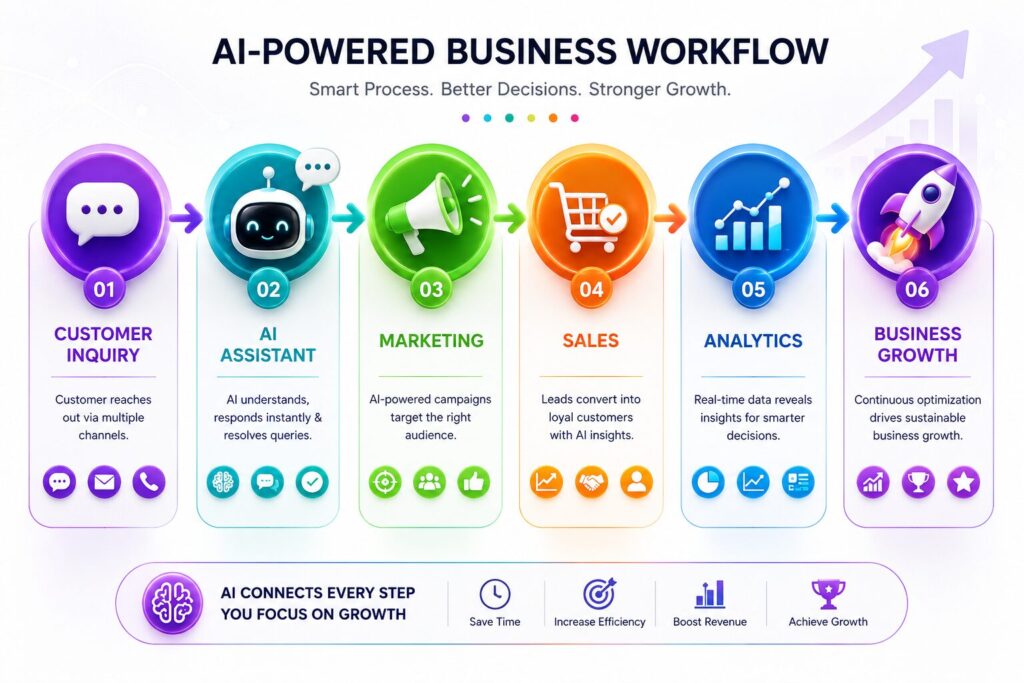
Small businesses often have limited staff and resources. AI helps by reducing manual work and improving efficiency.
Routine tasks such as writing product descriptions, replying to common customer questions, or organizing meeting notes can be completed much faster.
Instead of purchasing multiple software solutions, many AI platforms combine several productivity features into one application.
AI chat assistants can answer frequently asked questions instantly, helping customers even outside business hours.
Employees spend less time on repetitive work and more time on activities that require creativity, strategy, and human interaction.
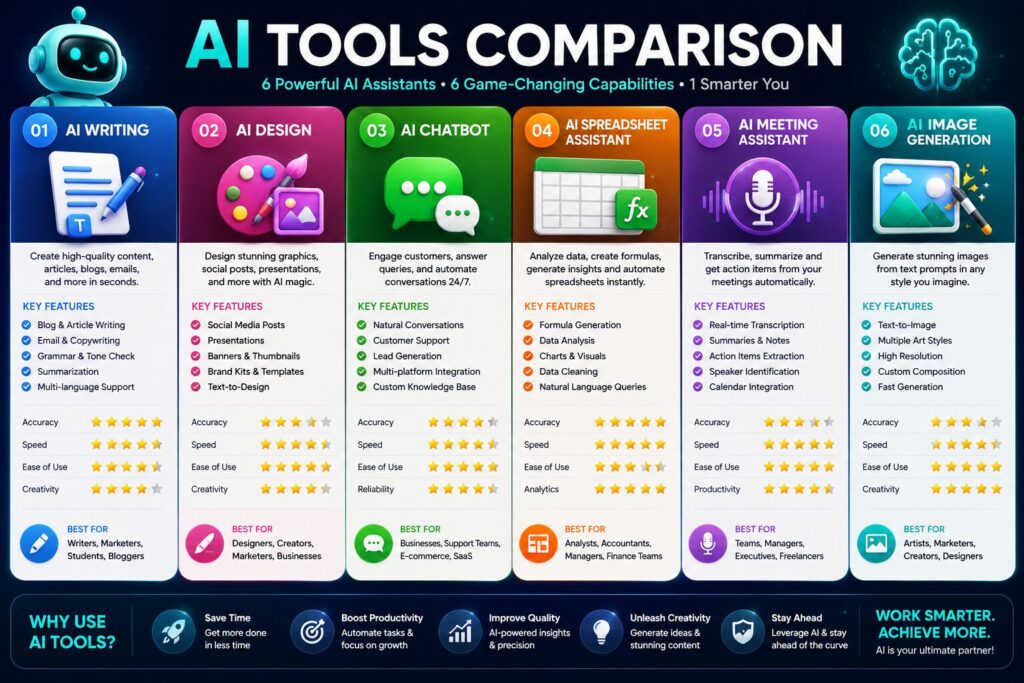
| Tool Category | Best For | Beginner Friendly | Free Plan |
|---|---|---|---|
| AI Writing Assistant | Content Creation | ⭐⭐⭐⭐⭐ | ✅ |
| AI Design Tool | Marketing Graphics | ⭐⭐⭐⭐⭐ | ✅ |
| AI Meeting Assistant | Meeting Notes | ⭐⭐⭐⭐ | ✅ |
| AI Chat Assistant | Customer Support | ⭐⭐⭐⭐ | ✅ |
| AI Spreadsheet Assistant | Data Analysis | ⭐⭐⭐ | Limited |
| AI Presentation Tool | Business Presentations | ⭐⭐⭐⭐⭐ | ✅ |
AI writing tools help create blogs, emails, advertisements, product descriptions, and social media content.
Design platforms now include AI features that generate banners, presentations, logos, social media posts, and promotional graphics within minutes.
Even users without graphic design experience can produce professional-looking visuals.
AI chat assistants help businesses respond to customer questions more quickly. They can answer common queries, guide visitors to the right products, and collect basic customer information before handing the conversation to a human agent.
Taking notes during meetings can be distracting. AI meeting assistants automatically organize conversations into clear summaries and action points.
They can help teams:
These tools are especially useful for remote teams and freelancers working with multiple clients.
Managing spreadsheets becomes easier with AI-powered assistance.
Instead of manually writing formulas or analyzing large datasets, AI can help:
Small business owners without advanced spreadsheet skills can make better use of their business data.
Creating business presentations often takes hours.
AI presentation tools help generate:
Most platforms provide ready-made layouts that can be customized to match your brand.
A neighborhood retail shop uses AI to create promotional social media posts, answer common customer questions through a website chat assistant, and analyze monthly sales reports.
A freelance designer uses AI writing tools for client proposals, AI presentation software for project pitches, and AI meeting assistants to organize client discussions.
A growing agency relies on AI to draft blog posts, design marketing graphics, summarize meetings, and manage internal documentation, allowing the team to handle more clients without increasing staff.
Not every business needs every AI tool. Start by identifying your biggest time-consuming tasks.
Ask yourself:
Choose tools that solve your biggest challenges first.
If your team has little technical experience, select software with a simple interface and good tutorials.
Many AI tools offer generous free plans. Test them before committing to a subscription.
Choose tools that work well with your existing software to avoid unnecessary manual work.
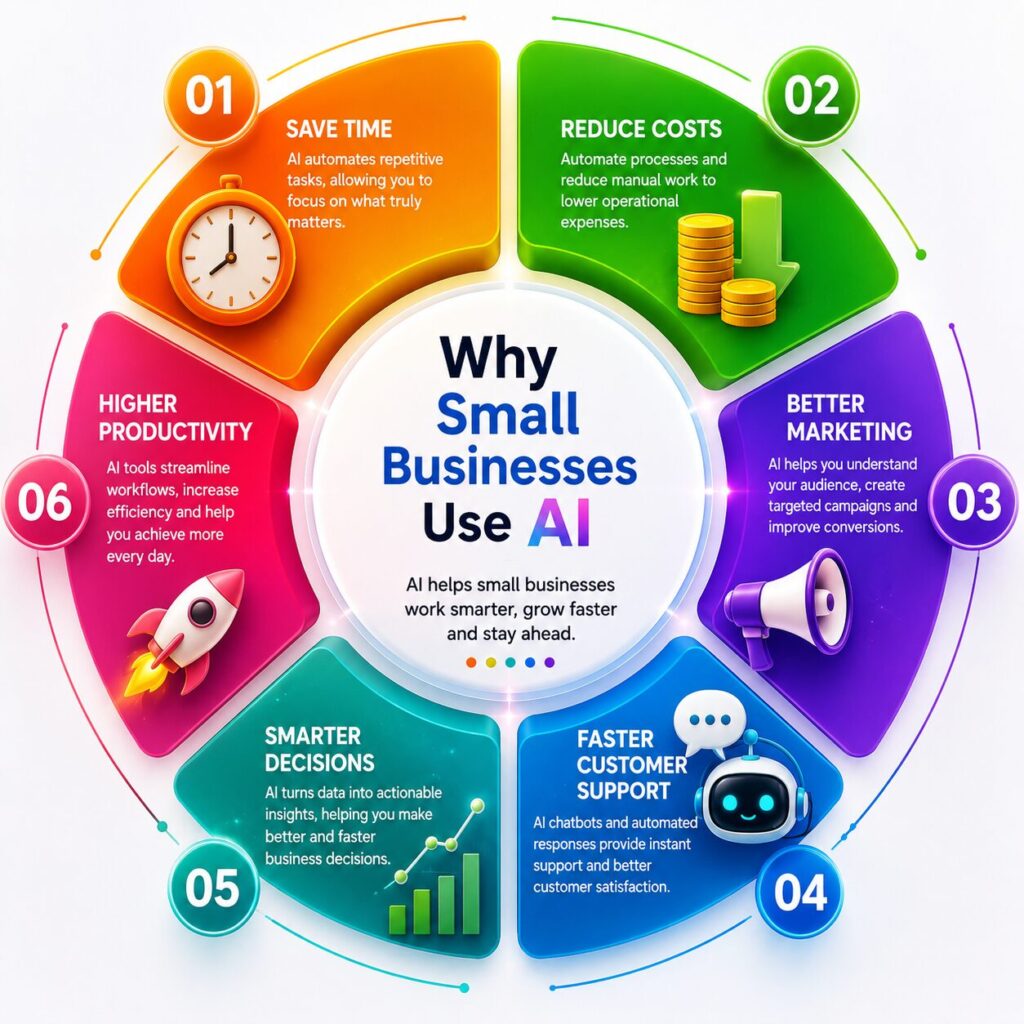
Businesses that use AI responsibly can gain several advantages.
Automating repetitive tasks allows employees to focus on strategic work.
AI can speed up the creation of blogs, email campaigns, advertisements, and product descriptions.
Quick responses improve customer satisfaction and reduce waiting times.
Analytics tools help business owners understand trends and make informed decisions.
Automation can reduce the need for repetitive manual work, helping businesses use their resources more efficiently.
Although AI tools are powerful, they are not perfect.
Keep these points in mind:
Avoid these common mistakes when adopting AI tools:
A gradual approach usually produces the best results.
They are software applications that help automate tasks such as writing, design, customer support, data analysis, and project management.
Many platforms offer free plans, while premium features are available through paid subscriptions.
Yes. AI can help save time, improve productivity, enhance customer service, and simplify everyday operations.
Start with the tool that addresses your biggest challenge, such as writing, customer support, design, or task management.
No. They are designed to assist with repetitive tasks so people can focus on higher-value work.
Most modern AI tools are beginner-friendly and provide tutorials or guided setup.
Choose reputable providers, review their privacy policies, and enable available security features to help protect your data.
Not every business needs every AI solution, but many can benefit from using one or two tools that solve specific workflow challenges.
Adopting AI Tools for Small Businesses doesn’t require a large budget or a technical background. The biggest advantage isn’t simply automation—it’s the ability to spend less time on repetitive tasks and more time serving customers, improving products, and growing your business.
Start small by choosing one tool that addresses a real need, whether that’s creating content, organizing meetings, improving customer support, or analyzing data. As your business grows, you can gradually expand your toolkit and integrate additional solutions into your workflow.
When used thoughtfully, AI can become a valuable business assistant that improves efficiency while allowing people to focus on creativity, relationships, and better decision-making.
This article is published by Tivorenza.com to help readers understand technology in a simple and practical way. We regularly update our AI guides to keep them accurate, beginner-friendly, and practical for students, freelancers, entrepreneurs, and small business owners.

