Physical Address
304 North Cardinal St.
Dorchester Center, MA 02124
Physical Address
304 North Cardinal St.
Dorchester Center, MA 02124

A year ago, walk into almost any office and the question on everyone’s mind was some version of “how do we start using AI?” Marketing teams wanted it for content, developers wanted it for code, ops teams wanted it for reports nobody had time to write. It was all upside, all excitement.
Ask around today and the tone has shifted. The question I keep hearing now isn’t how to use AI — it’s how to keep it from becoming a liability.
That’s not a small shift. It says something about where this technology actually is right now.
Generative AI stopped being a side experiment a while back. People use it to draft emails, summarize three-hour meetings, write code, dig through contracts, automate the boring parts of their job. Fine. But every one of those tools sitting inside a company is also a door — and doors need locks.
A few questions have started coming up in boardrooms that weren’t part of the conversation two years ago. Can sensitive company data leak out through one of these tools? What happens the day someone manages to trick an AI agent into doing something it shouldn’t? And when an automated system gets something badly wrong, whose desk does that land on?
Governments are asking these questions now. So are cybersecurity vendors. So are the people actually running enterprise IT. There’s a pretty consistent theme showing up across the industry: AI is speeding up both sides of this fight — the defenders and the attackers — and most organizations are still catching up.
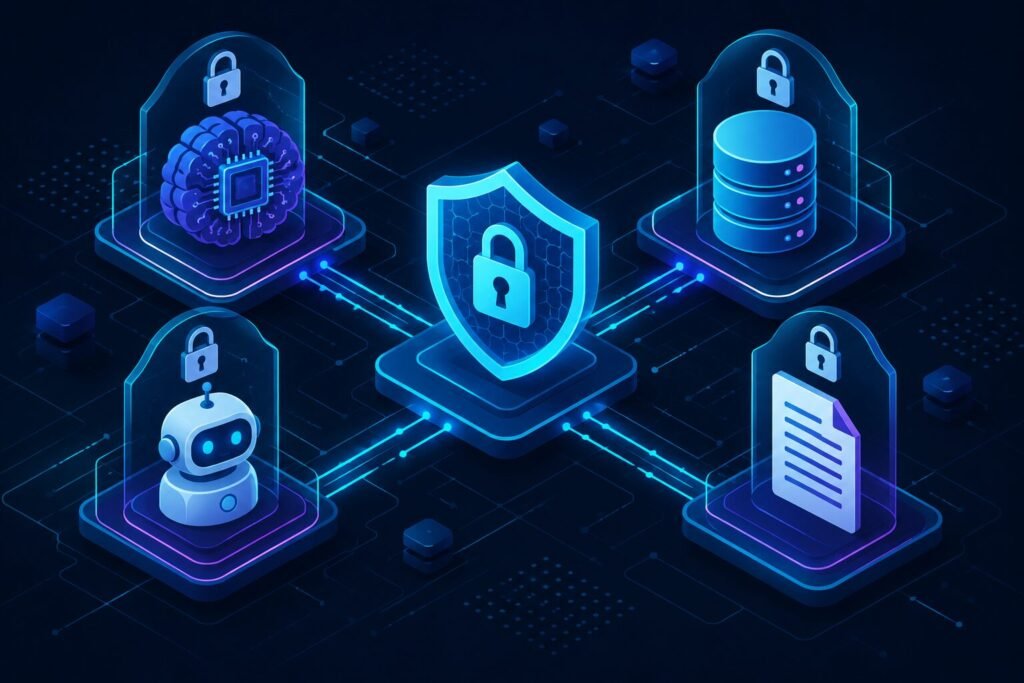
Old-school cybersecurity was mostly about protecting hardware — computers, servers, the network. Straightforward, in a sense. You knew what you were guarding.
AI throws a wrench into that.
Now the list of things that need protecting looks more like this:
Here’s the part that should worry people more than it currently does: one careless moment — someone pasting a confidential product roadmap into a random AI chatbot because it was convenient — can cause damage that no antivirus software on earth was built to catch.

AI hasn’t just added new tools to the workplace. It’s opened up entirely new places for attackers to poke at.
It used to be that attackers went after people or servers. Now they’re starting to go after the AI systems directly.
Prompt injection. This is the practice of trying to trick an AI assistant into abandoning its own instructions — basically talking it into doing something it was told not to.
Data leakage. Somebody’s intern pastes a client contract into a free AI tool to “clean up the wording,” not realizing that data doesn’t just disappear afterward.
Phishing that actually looks good now. Remember when you could spot a scam email by the terrible grammar? Those days are mostly gone. AI writes convincing, personalized messages in seconds, and that’s made social engineering a lot harder to catch by eye.
Agents with too much rope. As AI agents start handling multi-step tasks on their own — booking things, moving files, touching systems — someone has to make sure they can’t wander into places they were never supposed to go. A lot of security people I’ve read lately consider this the next real headache, not the current phishing wave.
Security has always been a bit of a chase. One side finds a new trick, the other side patches it, and round it goes.
AI just put both runners on faster shoes.
On the defense side, security vendors are building AI-driven tools that flag odd behavior, help investigate incidents, and take some of the grunt work off analysts’ plates. On the offense side, attackers are using the same kind of AI to speed up reconnaissance, sharpen their phishing, and generally move faster than they used to.
That tug-of-war is more or less why AI security has turned into one of the fastest-growing corners of enterprise spending right now.

It’s easy to write AI off as just a new headache. That’s not the whole picture, though.
A lot of modern security platforms lean on AI to:
None of this replaces human analysts, to be clear. What it does is cut down the hours they spend sifting through routine noise, so they can actually focus on the threats worth their attention.
Big companies get most of the headlines when something goes wrong. That doesn’t mean the smaller players are somehow immune — if anything, they often have fewer guardrails in place.
Plenty of small businesses are already running on:
Useful stuff, all of it. But without some basic ground rules about what employees can and can’t feed into these tools, productivity gains come with a quiet cost attached.
The lesson is pretty simple, honestly: saving twenty minutes isn’t worth it if it means confidential business information walks out the door.
Nobody’s suggesting companies stop using AI. That ship has sailed, and frankly it should have.
The more realistic move is using it with some discipline. A decent starting checklist looks like this:
Companies that treat AI as just another system to be governed — rather than some magic shortcut that bypasses the rules — tend to come out ahead in the long run.
AI has settled into daily work faster than most people expected it to, honestly.
That means AI security isn’t just an IT problem anymore. It’s landing on the desks of legal teams, HR, executives, developers — pretty much everyone.
If you ask me, the companies that end up winning this decade won’t necessarily be the ones using the most AI. They’ll be the ones who paired the innovation with some actual governance. That’s not a new lesson, either — new technology has always earned people’s trust slowly, and security is usually the thing that makes or breaks that trust.
The conversation has changed, and I think that’s a good thing.
Last year it was all about what AI could create. This year it’s shifting toward how to actually deploy it without blowing something up — protecting the sensitive stuff, keeping automated systems on a leash, using this technology responsibly instead of recklessly.
AI isn’t going anywhere. But every new capability drags a new responsibility along with it, whether companies are ready to admit that or not. The ones investing in AI security now will be in a much better spot when the next wave hits than the ones still treating it as an afterthought.

